- Thank you received: 0

'Safe' parallel charging boards
- Chris001
-
 Topic Author
- New Member
-

Less
More
27 Jan 2017 17:52 #11739
by Chris001
'Safe' parallel charging boards was created by Chris001
I parallel charge my lipo batteries and from day one have used so called 'safe' parallel charge boards, the 'safe' aspect comes form the use of fuses on the main power rail, and resettable polyfuses on the balance circuit. They cost more, but my thinking is that should anything go wrong, i.e a short, the fuse will go hopefully saving batteries and charger.
Alas, quality control can undo all the good intentions of the design when one of the main power rail fuses has a solder bridge connecting both sides of the fuse together.
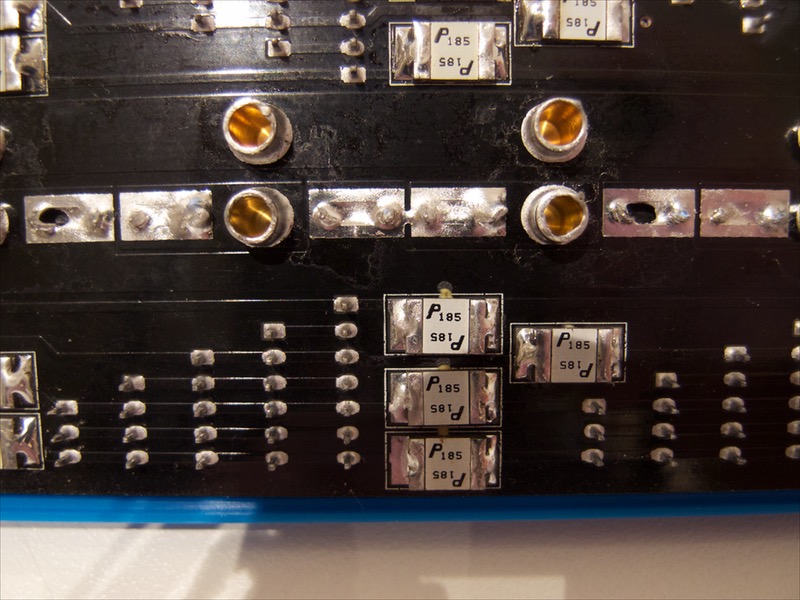
My guess is that with a 5000mAh 6S battery if I have a short the fuse and solder bridge will both go, but it's irritating to see that there has obviously been no testing or no visual inspection, and the product is being promoted as "safe"!
In future I think it would be prudent for me to test any charging boards as soon as I get them.
Alas, quality control can undo all the good intentions of the design when one of the main power rail fuses has a solder bridge connecting both sides of the fuse together.
My guess is that with a 5000mAh 6S battery if I have a short the fuse and solder bridge will both go, but it's irritating to see that there has obviously been no testing or no visual inspection, and the product is being promoted as "safe"!
In future I think it would be prudent for me to test any charging boards as soon as I get them.
Please Log in or Create an account to join the conversation.
- MikeSeale
-
- New Member
-
Less
More
- Thank you received: 0
27 Jan 2017 18:00 #11740
by MikeSeale
Replied by MikeSeale on topic 'Safe' parallel charging boards
I assume you've removed the bridge now?
Please Log in or Create an account to join the conversation.
- Chris001
-
Topic Author
- New Member
-
Less
More
- Thank you received: 0
27 Jan 2017 18:10 #11743
by Chris001
Replied by Chris001 on topic 'Safe' parallel charging boards
Not yet, it's the one I used when my batteries had 4mm bullet connectors, I'm using a different one at the moment for my batteries with 5.5mm connectors. The reason for digging it out was to make up some 4mm to 5.5mm leads so I can use it again. I was dusting it and out of curiously opened it up too have a look inside!
I've contacted the company I got it from just to let them know that their QC is a little iffy, but I have no intention of sending it back as it's an easy fix, I very much doubt I will hear from them, the hobby king version I got is actually a little neater looking, and no solder bridges!
I've contacted the company I got it from just to let them know that their QC is a little iffy, but I have no intention of sending it back as it's an easy fix, I very much doubt I will hear from them, the hobby king version I got is actually a little neater looking, and no solder bridges!
Please Log in or Create an account to join the conversation.
- kevinross
-

- Offline
- Platinum Member
-

Less
More
- Posts: 1023
- Thank you received: 583
27 Jan 2017 19:39 - 27 Jan 2017 19:43 #11748
by kevinross
Replied by kevinross on topic 'Safe' parallel charging boards
Chris
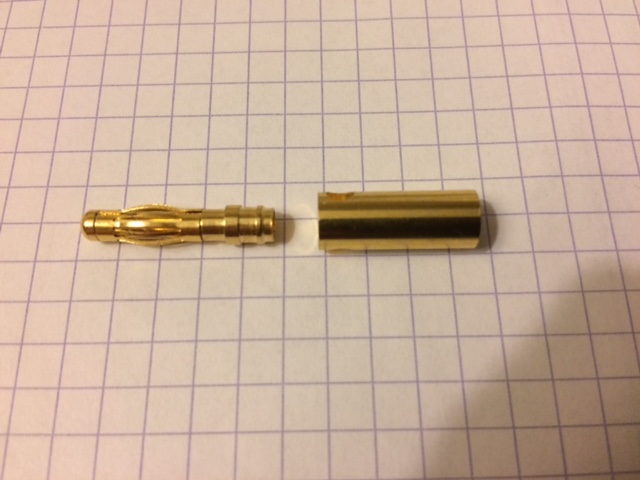
Rather than make adapter leads (where an additional / inline connection could short) have you considered direct soldering a 4mm male bullet to a 4.5mm female then heat shrink
Also - have you got one of these to remove the excess
www.maplin.co.uk/p/white-box-de-solder-p...CK49ECFWcq0wodG10AXg
Rather than make adapter leads (where an additional / inline connection could short) have you considered direct soldering a 4mm male bullet to a 4.5mm female then heat shrink
Also - have you got one of these to remove the excess
www.maplin.co.uk/p/white-box-de-solder-p...CK49ECFWcq0wodG10AXg
Last edit: 27 Jan 2017 19:43 by kevinross.
Please Log in or Create an account to join the conversation.
- Chris001
-
Topic Author
- New Member
-
Less
More
- Thank you received: 0
27 Jan 2017 20:20 #11750
by Chris001
Replied by Chris001 on topic 'Safe' parallel charging boards
Hi Kevin,
I'd not thought to do that, I'll have a play.
I've got a de-soldering pump, not as nice as that though, as in mine's not clear. By the way, Mapins seems to do the exact same pump for £8.99 www.maplin.co.uk/p/maplin-de-solder-pump-n40ch so good find at 66p from the same place!
I'd not thought to do that, I'll have a play.
I've got a de-soldering pump, not as nice as that though, as in mine's not clear. By the way, Mapins seems to do the exact same pump for £8.99 www.maplin.co.uk/p/maplin-de-solder-pump-n40ch so good find at 66p from the same place!
Please Log in or Create an account to join the conversation.
- JRI
-

- Offline
- Platinum Member
-
Less
More
- Posts: 502
- Thank you received: 108
28 Jan 2017 15:08 #11753
by JRI
Replied by JRI on topic 'Safe' parallel charging boards
I never really understood the technology or safety of parallel balance boards. The first pair of packs I connected to one resulted in the tracks on the board vaporising. Surely if one battery is at a higher voltage level to the other when they are connected, it is going to dump every amp it can into the lower one to bring it to the same level - and if the track thickness allows, this could be hundreds of amps?
Please Log in or Create an account to join the conversation.
- kevinross
-
- Offline
- Platinum Member
-
Less
More
- Posts: 1023
- Thank you received: 583
28 Jan 2017 17:18 #11755
by kevinross
Replied by kevinross on topic 'Safe' parallel charging boards
I have never charged packs in parallel.
Most battery chargers recommend you connect the balance lead first followed by the power leads. If i were to parallel charge, common sense would be to first connect the power sockets only and allow the overall cell voltages to stabilise before connecting the balance leads which would reduce the initial high current surges but certainly not eliminate them. I don't know what the polyfuse reaction time is but as they are a PTC device they obviously need current to heat before their resistance increases. - Hence your vaporising circuit tracks !
Most battery chargers recommend you connect the balance lead first followed by the power leads. If i were to parallel charge, common sense would be to first connect the power sockets only and allow the overall cell voltages to stabilise before connecting the balance leads which would reduce the initial high current surges but certainly not eliminate them. I don't know what the polyfuse reaction time is but as they are a PTC device they obviously need current to heat before their resistance increases. - Hence your vaporising circuit tracks !
Please Log in or Create an account to join the conversation.
- Phil Ford
-

- Offline
- Moderator
-

Less
More
- Posts: 3156
- Thank you received: 903
28 Jan 2017 17:58 - 28 Jan 2017 17:58 #11757
by Phil Ford
Nor me! I have a 4 channel charger, that is 4 of same or different batteries and technology charging all at same time.
Replied by Phil Ford on topic 'Safe' parallel charging boards
kevinross wrote: I have never charged packs in parallel.
Nor me! I have a 4 channel charger, that is 4 of same or different batteries and technology charging all at same time.
Last edit: 28 Jan 2017 17:58 by Phil Ford.
Please Log in or Create an account to join the conversation.
- 4Pedalsfly
-

- Offline
- Platinum Member
-
Less
More
- Posts: 800
- Thank you received: 202
29 Jan 2017 10:23 #11761
by 4Pedalsfly
Replied by 4Pedalsfly on topic 'Safe' parallel charging boards
Nor me either , I have 2 chargers & always balance charge after each usage.
However what is "interesting" is the different cell voltages given on the charger compared to
readings on so called battery checkers. Different brands also giving different readings.
It would be interesting to know if anyone has carried out any comparisons using laboratory
grade equipment.
Colin.
However what is "interesting" is the different cell voltages given on the charger compared to
readings on so called battery checkers. Different brands also giving different readings.
It would be interesting to know if anyone has carried out any comparisons using laboratory
grade equipment.
Colin.
Please Log in or Create an account to join the conversation.
- Chris001
-
Topic Author
- New Member
-
Less
More
- Thank you received: 0
29 Jan 2017 10:42 #11762
by Chris001
Replied by Chris001 on topic 'Safe' parallel charging boards
I always balance charge, at the end of the day I charge the batteries back up to storage voltage independently, when I come to charge my batteries for a days flying they are all essentially at the same voltage, and so I parallel charge them. I connect the power leads first.
Colin, you'd have thought that voltage readings would be very similar from measuring device to measuring device, but like you I see variations. I guess it comes down to what you're prepared to pay for. If you look at electrical components they will state their accuracy, so a carbon composition resistor might have an accuracy of +/-5%, metal film resistors might be +/-0.1% one will be more expensive than the other. I only use the battery checker to check which is the full battery.
Colin, you'd have thought that voltage readings would be very similar from measuring device to measuring device, but like you I see variations. I guess it comes down to what you're prepared to pay for. If you look at electrical components they will state their accuracy, so a carbon composition resistor might have an accuracy of +/-5%, metal film resistors might be +/-0.1% one will be more expensive than the other. I only use the battery checker to check which is the full battery.
Please Log in or Create an account to join the conversation.
Moderators: DaveBright
Time to create page: 0.468 seconds
©
2009 - 2026
WMAC PCF Design