- Thank you received: 0

aerobatics design theory
- Adrian
-
 Topic Author
- New Member
-

Less
More
15 Oct 2015 13:51 #6470
by Adrian
aerobatics design theory was created by Adrian
Hi guys,
brushing up on my aircraft design theory, its been a while since I looked at it and have never really had cause to pay too much attention to the knife edge portion of the flight envelope.
being short on money and rich on time I figured its time to have a play and get a better understanding of what's going on and replace the rather tired MX2 foamy airframe with something that flies a bit better.
does anybody have any insights into fuz side area? able to point me in the direction of some info?
I think I have a basic understanding of how the positioning of the side area of the fuz affects how the model rolls and how much rudder is required to maintain knife edge. Just after some more detail and maybe some rough rules of thumb?
thanks!
brushing up on my aircraft design theory, its been a while since I looked at it and have never really had cause to pay too much attention to the knife edge portion of the flight envelope.
being short on money and rich on time I figured its time to have a play and get a better understanding of what's going on and replace the rather tired MX2 foamy airframe with something that flies a bit better.
does anybody have any insights into fuz side area? able to point me in the direction of some info?
I think I have a basic understanding of how the positioning of the side area of the fuz affects how the model rolls and how much rudder is required to maintain knife edge. Just after some more detail and maybe some rough rules of thumb?
thanks!
Please Log in or Create an account to join the conversation.
- JonTappin
-
- Offline
- Platinum Member
-

Less
More
- Posts: 1178
- Thank you received: 265
15 Oct 2015 22:35 #6508
by JonTappin
Replied by JonTappin on topic aerobatics design theory
Hi Ade
I don't claim to be an aerodynamics expert but can comment from experience.
Knife edge flight basically depends on side area, the more you have, the better the knife edge performance. Generally speaking the side area at or in front of the cg is the most effective, you only have to look at f3a designs through the ages to see this. As knife edge flight became more common in f3a manoeuvres through the years fuselage depths increased, also canalisers were then introduced to further increase rudder power, as I understand the theory is that the device channels the air along the fuselage and stops it rolling off the fuselage, therefore increasing lift, this effect also happens with biplanes. The full size Pitts is one of the few aeroplanes that can sustain knife edge flight.
The fus shape doesn't have as much bearing on rolling (or pitching) with rudder as other factors. For roll couple, the dihedral angle can be adjusted to remove this. Low wings will need some dihedral, mid wings will need less or possibly none at all, high wings need anhedral.
Pitch coupling is affected by relative position of the wing and tail above or below the fus centre line, cg position, relative wing and tail areas etc. Most modern f3a and IMAC designs tend to have mid wings with the wing and tail centre lines in line. Full size aerobatic aircraft tend to have lower wings, but this is for forward visibility for the pilot, tails tend to be higher but for structural reasons. They don't have spring centred sticks so pitch couple is less of an issue for full size pilots.
Hope that helps, it probably also answers some questions you didn't even ask
I don't claim to be an aerodynamics expert but can comment from experience.
Knife edge flight basically depends on side area, the more you have, the better the knife edge performance. Generally speaking the side area at or in front of the cg is the most effective, you only have to look at f3a designs through the ages to see this. As knife edge flight became more common in f3a manoeuvres through the years fuselage depths increased, also canalisers were then introduced to further increase rudder power, as I understand the theory is that the device channels the air along the fuselage and stops it rolling off the fuselage, therefore increasing lift, this effect also happens with biplanes. The full size Pitts is one of the few aeroplanes that can sustain knife edge flight.
The fus shape doesn't have as much bearing on rolling (or pitching) with rudder as other factors. For roll couple, the dihedral angle can be adjusted to remove this. Low wings will need some dihedral, mid wings will need less or possibly none at all, high wings need anhedral.
Pitch coupling is affected by relative position of the wing and tail above or below the fus centre line, cg position, relative wing and tail areas etc. Most modern f3a and IMAC designs tend to have mid wings with the wing and tail centre lines in line. Full size aerobatic aircraft tend to have lower wings, but this is for forward visibility for the pilot, tails tend to be higher but for structural reasons. They don't have spring centred sticks so pitch couple is less of an issue for full size pilots.
Hope that helps, it probably also answers some questions you didn't even ask
The following user(s) said Thank You: Adrian
Please Log in or Create an account to join the conversation.
- JonTappin
-
- Offline
- Platinum Member
-
Less
More
- Posts: 1178
- Thank you received: 265
15 Oct 2015 22:44 - 15 Oct 2015 22:46 #6511
by JonTappin

70's
Replied by JonTappin on topic aerobatics design theory
70's
Last edit: 15 Oct 2015 22:46 by JonTappin.
The following user(s) said Thank You: Adrian
Please Log in or Create an account to join the conversation.
- JonTappin
-
- Offline
- Platinum Member
-
Less
More
- Posts: 1178
- Thank you received: 265
15 Oct 2015 22:46 #6512
by JonTappin

80's (late)
Replied by JonTappin on topic aerobatics design theory
80's (late)
The following user(s) said Thank You: Adrian
Please Log in or Create an account to join the conversation.
- JonTappin
-
- Offline
- Platinum Member
-
Less
More
- Posts: 1178
- Thank you received: 265
15 Oct 2015 22:47 #6513
by JonTappin
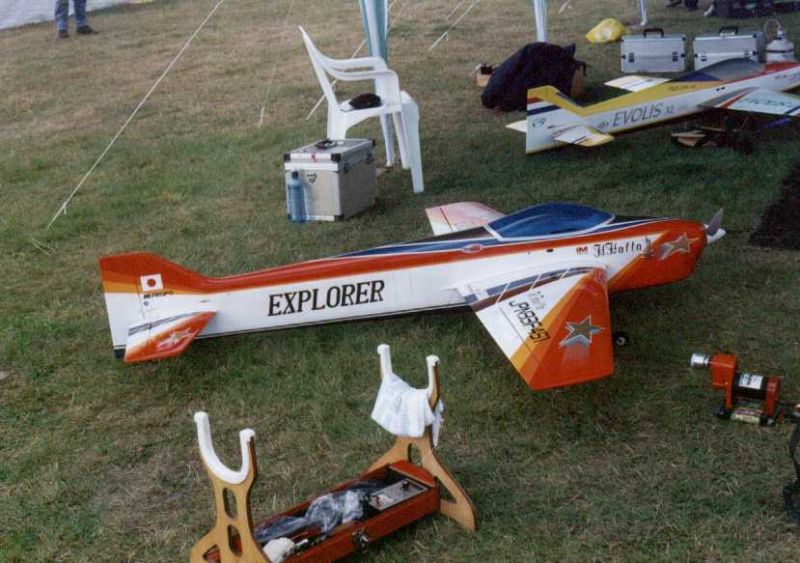
90's
Replied by JonTappin on topic aerobatics design theory
90's
The following user(s) said Thank You: Adrian
Please Log in or Create an account to join the conversation.
- Adrian
-
Topic Author
- New Member
-
Less
More
- Thank you received: 0
15 Oct 2015 22:47 #6514
by Adrian
Replied by Adrian on topic aerobatics design theory
Canilisers! thats what those things that are a bit reminiscent of F1 from a few years back are called!
thanks Jon, that's exactly what I was after
so....
in terms of profile,
if we take a line from the motor shaft down through the wing centre line then tail should be in line too. keep as much area as possible in front of the CG.
does the position vertically of the area affect roll coupling? eg if more than 50% of the area was above the motor/wing/tail line would it give roll coupling?
what about fin/rudder area should that be kept as close to centre line as possible too?
plan form:
Straight leading edge should give least yaw to roll coupling?
thanks Jon, that's exactly what I was after
so....
in terms of profile,
if we take a line from the motor shaft down through the wing centre line then tail should be in line too. keep as much area as possible in front of the CG.
does the position vertically of the area affect roll coupling? eg if more than 50% of the area was above the motor/wing/tail line would it give roll coupling?
what about fin/rudder area should that be kept as close to centre line as possible too?
plan form:
Straight leading edge should give least yaw to roll coupling?
Please Log in or Create an account to join the conversation.
- JonTappin
-
- Offline
- Platinum Member
-
Less
More
- Posts: 1178
- Thank you received: 265
15 Oct 2015 22:48 #6515
by JonTappin

Current
Replied by JonTappin on topic aerobatics design theory
Current
Please Log in or Create an account to join the conversation.
- JonTappin
-
- Offline
- Platinum Member
-
Less
More
- Posts: 1178
- Thank you received: 265
15 Oct 2015 22:57 - 15 Oct 2015 23:04 #6516
by JonTappin
Replied by JonTappin on topic aerobatics design theory
Adrian wrote: Canilisers! thats what those things that are a bit reminiscent of F1 from a few years back are called!
thanks Jon, that's exactly what I was after
so....
in terms of profile,
if we take a line from the motor shaft down through the wing centre line then tail should be in line too. keep as much area as possible in front of the CG.
Pretty much, yes
does the position vertically of the area affect roll coupling? eg if more than 50% of the area was above the motor/wing/tail line would it give roll coupling?
what about fin/rudder area should that be kept as close to centre line as possible too?
Truth is everything has an effect in some way, because of the lower tail the fin area above will always be greater than below the tail. The good news is that roll couple can easily be removed with a mixer
plan form:
Straight leading edge should give least yaw to roll coupling?
No straight or swept leading edge has little affect on roll couple, height of wing above or below centre line and dihedral angle are the main issues
Last edit: 15 Oct 2015 23:04 by JonTappin.
The following user(s) said Thank You: Adrian
Please Log in or Create an account to join the conversation.
- Adrian
-
Topic Author
- New Member
-
Less
More
- Thank you received: 0
15 Oct 2015 23:01 #6518
by Adrian
Replied by Adrian on topic aerobatics design theory
looking at those pictures F3A really hasnt changed that much other than gaining some side area.
all have straight trailing edges, lowish wings, motors appear to be on the tail line.
I like that they arent scale.
don't get me wrong, scale has its place in the sport but for aerobatic models they have a job to fill and by making them scaleish that compromises the design and handling of the model.
scale should be scale and making the model fly nicely with the compromised handling that a scale plan form brings is part of the skill.
it bugs me that a lot of the 3d stuff is based upon their full size counterparts.
anyway, i digress...
what about beyond the stall? harriers and the like, my mx2 has a pretty knarly flick when doing rolling harriers that makes it hard to keep the roll rate nice and constant. Is that purely wing section related?
all have straight trailing edges, lowish wings, motors appear to be on the tail line.
I like that they arent scale.
don't get me wrong, scale has its place in the sport but for aerobatic models they have a job to fill and by making them scaleish that compromises the design and handling of the model.
scale should be scale and making the model fly nicely with the compromised handling that a scale plan form brings is part of the skill.
it bugs me that a lot of the 3d stuff is based upon their full size counterparts.
anyway, i digress...
what about beyond the stall? harriers and the like, my mx2 has a pretty knarly flick when doing rolling harriers that makes it hard to keep the roll rate nice and constant. Is that purely wing section related?
Please Log in or Create an account to join the conversation.
- JonTappin
-
- Offline
- Platinum Member
-
Less
More
- Posts: 1178
- Thank you received: 265
15 Oct 2015 23:15 #6519
by JonTappin
Interesting point about scale 3d, there was a period around early 2000 when there were a few 'freestyle 3d' models developed from f3a like the Majestic, but they seemed to disappear? Maybe scale based stuff sells better?
Harriers is one area where a straight leading edge does help, this is why the Edge 540 designs do well at 3d, it seems to delay the tip stall. Your foamy MX2 is more likely a bit flicky as it is relatively small so the wing loading will be higher, the bigger models are definately more forgiving.
Replied by JonTappin on topic aerobatics design theory
Adrian wrote: looking at those pictures F3A really hasnt changed that much other than gaining some side area.
all have straight trailing edges, lowish wings, motors appear to be on the tail line.
I like that they arent scale.
don't get me wrong, scale has its place in the sport but for aerobatic models they have a job to fill and by making them scaleish that compromises the design and handling of the model.
scale should be scale and making the model fly nicely with the compromised handling that a scale plan form brings is part of the skill.
it bugs me that a lot of the 3d stuff is based upon their full size counterparts.
anyway, i digress...
what about beyond the stall? harriers and the like, my mx2 has a pretty knarly flick when doing rolling harriers that makes it hard to keep the roll rate nice and constant. Is that purely wing section related?
Interesting point about scale 3d, there was a period around early 2000 when there were a few 'freestyle 3d' models developed from f3a like the Majestic, but they seemed to disappear? Maybe scale based stuff sells better?
Harriers is one area where a straight leading edge does help, this is why the Edge 540 designs do well at 3d, it seems to delay the tip stall. Your foamy MX2 is more likely a bit flicky as it is relatively small so the wing loading will be higher, the bigger models are definately more forgiving.
Please Log in or Create an account to join the conversation.
Moderators: DaveBright
Time to create page: 0.398 seconds
©
2009 - 2026
WMAC PCF Design